Image credit: Stabila / ITS Hub (reference only)
A laser level that you can actually see in daylight is not a small thing. Most trades who have used a cheap red-beam laser indoors will know the frustration: tilt the tool slightly, open a window, or work under fluorescent lights, and the line becomes almost invisible. The Stabila LAX 60 G addresses that directly. It uses a green laser diode, and the result is a beam that your eye registers far more easily under the kind of lighting conditions you actually work in.
This is not a high-end rotary laser for large commercial sites. The LAX 60 G is a compact cross-line tool aimed at joiners, tilers, electricians, plumbers, and builders doing internal layout work where speed and accuracy matter more than long range. Here is what it does, who it suits, and what the green beam actually means in practical terms.
What the Stabila LAX 60 G does
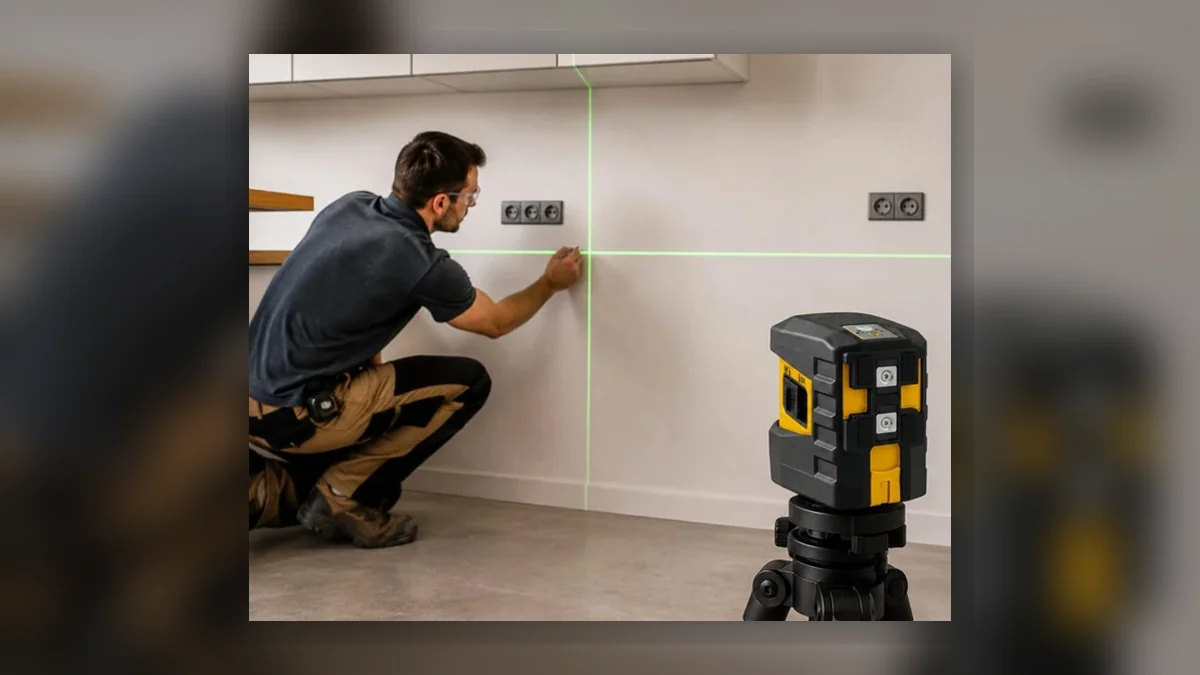
The LAX 60 G projects two laser lines at 90 degrees to each other: one horizontal, one vertical. Both lines appear at the same time, giving you a full cross on the wall or surface you are working on.
The tool self-levels automatically. Place it on a flat surface or on a Stabila tripod, switch it on, and it finds true horizontal and vertical within a few seconds by using a pendulum mechanism inside the housing. You do not have to manually adjust it with bubble vials. If the surface is too uneven for self-levelling (outside of roughly 4 degrees from level), the tool will blink the lines to warn you rather than silently projecting a false reading.
That warning behaviour matters. A laser that gives you a confident, straight-looking line that is actually 1 or 2 degrees out of level will cause errors that only become obvious after tiles are laid or skirting boards are fixed. Stabila's out-of-level warning is a basic but important safety feature.
Green beam vs red beam: what it actually means on site
The difference between a green laser and a red one is about how the human eye responds to different wavelengths of light. Green light sits roughly in the middle of the visible spectrum, and our eyes are more sensitive to it than they are to red. The effect on site is that a green beam looks approximately four times brighter than a red beam producing the same output power.
In practical terms this means you can see the line from further away, and you can see it in brighter ambient light. Working in a room with all the windows open, or near a rooflight, makes a red laser difficult to read. A green laser stays visible in those conditions without needing to close up the space or wait for lower light.
The trade-off is battery life. Green laser diodes use more power than red ones, so the LAX 60 G will run for fewer hours per charge or per set of batteries than an equivalent red-beam tool. For most internal work tasks this is not a significant limitation, but if you are setting out in a long session, it is worth keeping spare batteries in the bag.
What trades use it for
Cross-line lasers like the LAX 60 G are most useful for layout tasks where you need a consistent horizontal or vertical reference across a room or bay.
Tilers use them to establish a starting grid. Fitting a full field of tiles is much faster when you can project a level horizontal line across the wall and drop a vertical from it, rather than snapping chalk lines for every course.
Electricians use them for socket and switch heights. When fitting a run of socket outlets at the same height across a long wall, a horizontal laser line lets you mark multiple positions in one pass without measuring from the floor at each point.
Joiners and carpenters use them for setting out stud partitions, hanging door linings at a consistent reveal, aligning shelving units, and checking that window and door frames are plumb.
Plumbers use the vertical line for checking pipe runs and radiator valve positions across a wall.
In each case, the LAX 60 G is doing the same job as a good spirit level and a straight edge, but faster and over a longer distance. The time saving on a day's tiling or a full floor of socket heights adds up.
Working range and detector use
Stabila quotes a working range for the LAX 60 G that suits most interior situations. In low light you can read the line across a typical room with no issue. In brighter conditions, the visible range shortens, but it remains usable for the tasks described above.
For longer ranges or bright exterior conditions, Stabila lasers can be used with a receiver detector. The detector picks up the laser signal even when the naked eye cannot, extending the practical working range significantly. If you are setting out over longer distances, such as across a large open-plan refurbishment floor, a receiver turns this tool into a much more capable instrument than it appears on its own.
Build quality and the Stabila name
Stabila is a German precision instruments manufacturer with a long history in the UK trade market. Their spirit levels are used as a benchmark for quality in the joinery and building trades, and the LAX series laser levels carry the same manufacturing standards.
The LAX 60 G is built for site use, with a tough housing. It is not IP-rated for heavy water exposure in the way that some outdoor-rated tools are, so it is intended for interior use or sheltered exterior conditions rather than exposure to rain.
The tool comes with a ceiling clamp and a magnetic mounting bracket as standard, giving you flexible options for positioning it without a tripod. The ceiling clamp is particularly useful for tiling where you want the laser positioned directly above the working surface.
Who the LAX 60 G is for
The LAX 60 G is best suited to trades who do a lot of internal fit-out work and want a reliable, fast cross-line laser that is noticeably easier to see than a red-beam alternative. It is not a long-range or high-precision survey instrument, but for the work it is designed around, the green beam makes a genuine practical difference.
If you are currently using a red cross-line laser and finding yourself working around the beam visibility in well-lit rooms, the LAX 60 G is the straightforward upgrade. If you are buying your first laser level, the green beam is worth the small additional cost over entry-level red options.
Frequently Asked Questions
What is the Stabila LAX 60 G used for? The Stabila LAX 60 G is a cross-line laser level used for indoor layout tasks including tiling, socket and switch positioning, stud partition setting-out, door and window frame alignment, and shelf installation. It projects a horizontal and a vertical line simultaneously.
Why is a green laser better than a red laser? The human eye is more sensitive to green light than red. A green laser beam appears approximately four times brighter than a red beam at the same power output, making it easier to see in daylight and under artificial site lighting without needing to darken the room.
Does the Stabila LAX 60 G self-level? Yes. The LAX 60 G uses a pendulum-based self-levelling system. When placed on a reasonably flat surface it finds true horizontal and vertical automatically within a few seconds. If the surface is too uneven, the lines blink to warn you, rather than projecting a false level.
What is the working range of the Stabila LAX 60 G? The visible working range depends on ambient light conditions. In standard indoor lighting the beam is clearly readable across typical room distances. Used with a compatible Stabila receiver detector, the working range extends considerably for larger spaces or brighter conditions.
Can I use the Stabila LAX 60 G for outdoor work? The LAX 60 G is designed primarily for interior use or sheltered exterior conditions. It is not rated for use in rain or heavy exposure to the elements. For outdoor work in daylight, a detector is needed to read the beam accurately.
What accessories come with the Stabila LAX 60 G? The LAX 60 G typically comes with a ceiling clamp and a magnetic mounting bracket, allowing it to be used without a separate tripod in most interior situations.
Is Stabila a reliable brand for laser levels? Stabila is a German precision instruments manufacturer with a strong reputation in the UK trade market, particularly for spirit levels. Their LAX range of laser levels is built to the same quality standards and is used across joinery, tiling, electrical, and building trades.