
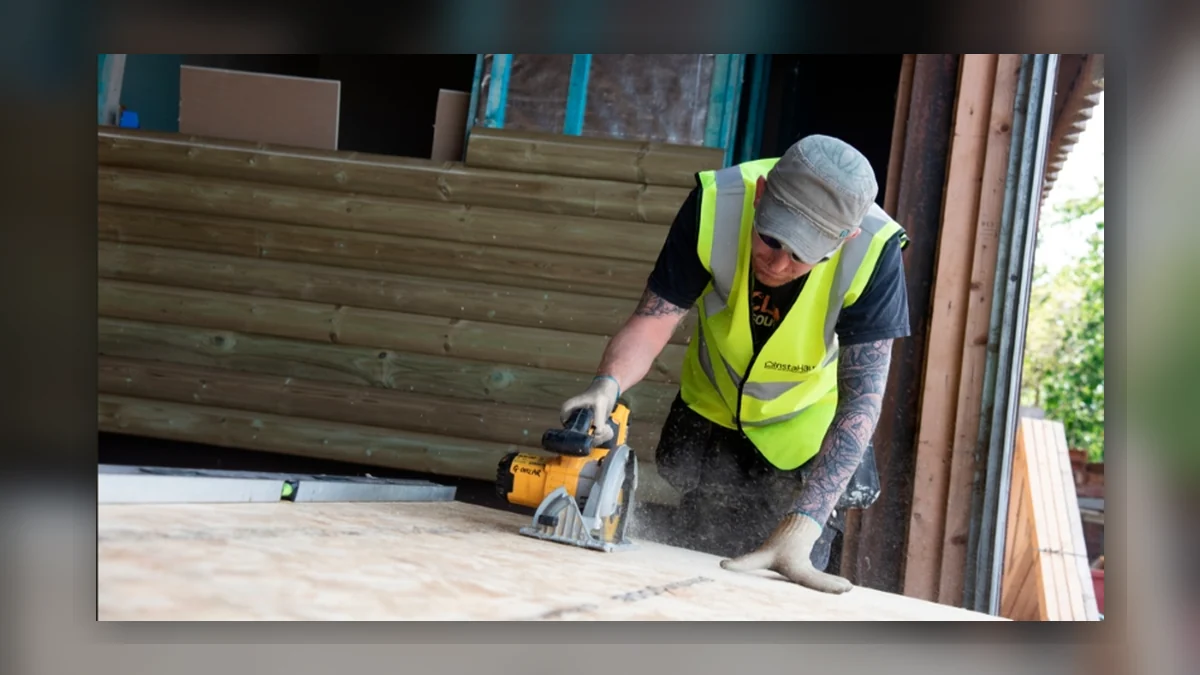
West Fraser has been pushing the case for using oriented strand board (OSB) as an alternative to plasterboard in internal partitions and wall linings. The argument is partly environmental and partly practical, and for tradespeople who regularly specify or install internal walling, it is worth understanding.
The problem with plasterboard in landfill
Plasterboard is made from gypsum, a calcium sulphate mineral, sandwiched between two layers of paper or fibreboard. When it gets wet in landfill, the gypsum breaks down and produces hydrogen sulphide, a toxic gas with a distinctive rotten-egg smell. Hydrogen sulphide at low concentrations is unpleasant; at higher concentrations it is hazardous.
This chemistry is why the UK government classifies gypsum-containing waste as hazardous at landfill under the Landfill (England and Wales) Regulations. Tradespeople who dispose of plasterboard in general skip waste are potentially in breach of those regulations, and tip charges for hazardous waste classification are higher than for standard mixed builders' waste.
The waste problem is substantial. The UK construction industry generates large volumes of plasterboard offcut waste every year, most of it from renovation work where existing plasterboard is stripped and new board is cut to fit.
What OSB offers
Oriented strand board is an engineered wood panel. Strands of wood are layered and bonded under pressure with resin, with each layer oriented at right angles to the next, similar in principle to plywood. The result is a panel with consistent structural properties across its face.
The key advantage over plasterboard in the context West Fraser is making is that OSB does not have the hazardous waste classification problem. It is timber-based, and while it contains resin binders, it does not produce toxic gases in landfill at the same scale or risk level.
From a structural perspective, OSB is significantly stiffer and stronger than standard plasterboard. A 12mm OSB3 panel (the grade specified for internal use and conditions where some moisture exposure is possible) will accept a screw or nail fixing without needing to locate a stud behind it, which simplifies cabinet installation and shelving in a way plasterboard cannot match.
Where OSB makes practical sense as a plasterboard replacement
Internal stud partitions where the finish is industrial or utilitarian: warehouses, workshops, utility rooms, garages, and plant rooms. OSB on a stud frame gives a harder, screw-accepting surface that withstands the sort of treatment a plastered plasterboard wall would not.
Wall linings where boarding shelves, racking, or equipment is the intent from the start: a tool store, a transit van conversion, a workshop fitout. Fixing a tool rail or heavy shelf bracket into OSB requires no wall plug; a direct wood screw into 18mm OSB holds reliably.
Renovation projects where the specification is flexible and the client is open to sustainable alternatives: if you are replastering after a strip-out anyway, raising OSB as the substrate opens a conversation about specification that some clients will welcome.
Where OSB is not the right answer
Plasterboard is specified in most domestic and commercial interiors because it is light, easy to cut with a standard knife and straightedge, easy to finish, and carries fire resistance ratings in specific thicknesses. The Euroclass E fire rating of standard OSB is lower than the Class 0 achievable with fire-rated plasterboard. Where fire performance is specified in a building control application, plasterboard's fire rating is part of the reason it is used, and OSB does not match it directly.
For any application where sound reduction matters (party walls, bedroom partitions, hotel room construction) plasterboard has specific acoustic ratings backed by tested partition systems. OSB does not have the same body of acoustic testing in typical domestic partition applications.
Tooling implications
If you are working with OSB rather than plasterboard, the cutting approach changes. A standard plasterboard knife cuts plasterboard. OSB requires a circular saw, jigsaw, or reciprocating saw. Dust management becomes more important because OSB sawdust is finer and carries resin particles. Use appropriate dust extraction and a P2 dust mask.
Fastening is straightforward: OSB3 accepts timber screws, ring shank nails, and staples without predrilling for standard sizes.
Frequently Asked Questions
Can OSB be used instead of plasterboard for internal walls? In principle yes, but OSB has different fire resistance ratings and acoustic properties to plasterboard. It is a practical choice in utility and industrial applications, workshops, and where structural wall properties matter more than fire or acoustic ratings. For domestic living spaces subject to building regulations, confirm fire performance requirements with a building control officer before specifying OSB instead of plasterboard.
Why is plasterboard classified as hazardous waste? Gypsum-based waste (including plasterboard) is classified as hazardous at landfill in England and Wales because the gypsum reacts with organic material in the presence of water to produce hydrogen sulphide gas, which is toxic.
Is OSB stronger than plasterboard? Yes. OSB3 (the standard grade for internal use) is significantly stiffer and stronger than standard plasterboard of the same thickness. It will accept direct screw and nail fixings without wall plugs across its face.
Does OSB need to be plastered? Not if the application does not require a skim finish. OSB can be used directly as a wall lining in industrial or utilitarian settings, or finished with a decorative facing (plywood, cladding panels, direct paint with appropriate primer). For a smooth plastered finish matching a plasterboard wall, a skim coat can be applied over an appropriate plaster bonding agent.
What grade of OSB is suitable for internal walls? OSB3 is the standard specification for internal use where some moisture exposure is possible (such as a utility room or bathroom wall lining). OSB2 is for dry internal conditions only.